Though a tropical storm was hitting New Brunswick and parts of Nova Scotia, our ferry was scheduled to leave Port aux Basques on time.  We noticed that there were not nearly as many of us in line waiting to go back to Nova Scotia as there had been when we were coming to Newfoundland.
 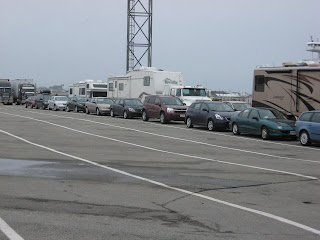 The ship was on time and we loaded and made our way up to the deck where we would be for the next six hours. By the time we were ready to leave port, the captain announced that we would be sitting for a while til the wind died down. About two hours later, we finally left Port aux Basques and had a pretty uneventful trip across the water, though it was quite rocky at times. We spent the night at the Arms of Gold campground in North Sydney and left early the next morning to drive to Baddeck to see the Alexander Graham Bell Museum.
  Along the way, we noticed that the colors of the leaves are just starting to change.
The Alexander Graham Bell Museum explores the life of a very remarkable person whose achievements have touched all of us. Artifacts, audio-visual programs and photographs tell the story of Alexander Graham Bell, a story filled with family, friends, associates and a magnificent family home still privately owned by his descendants. As a teacher, inventor and most of all a humanitarian, Bell bridged the world between sound and silence, teaching deaf people to speak and pursue ideas from transmitting sound on light to treadle-powered graphophones.
Alexander Graham Bell was born in Edinburgh, Scotland in 1847. He grew up in a family where speech and hearing were very important. His mother was an accomplished pianist, despite severe and growing deafness. Bell had just started his teaching career when tragedy struck. In 1867, his younger brother died from tuberculosis. In 1870, his older brother also died from the same disease and soon Alex was in poor health. His father decided to move the family to Ontario for a better climate.
By 1870, the race was on to improve the telegraph. Ambitious and needing money, Bell took up the challenge. Bell knew something about electricity and a lot about sound, speech and hearing. A daring idea formed in his mind: an electrical device, working much like the human ear that would transmit speech itself – a talking wire. By 1875, Bell had found a gifted assistant, Thomas Watson. On a hot day in June 1875, Watson accidentally plucked a transmitter reed on Bell’s apparatus. Bell in another room heard a sound. Watson had unexpectedly generated an electric current strong enough to activate Bell’s receiver. Could voice pulsations do the same? Bell quickly modified his apparatus and Watson could hear the muffled sound of Bell’s voice. The telephone was born! Bell received the telephone patent in February, 1876, but his apparatus had yet to transmit a clear intelligible sentence. Then on March 10, 1876, Bell’s call “Mr. Watson come here, I need you!” was clearly heard by Watson in another room. Bell’s invention was now a working reality.
While struggling with his experiments, Bell fell in love with his pupil, Mabel Hubbard. He had greatly improved her ability to speak. She helped Bell thru the many frustrations and disappointments that preceded his telephone triumph. On her 18th birthday Mabel, with her parents consent, agreed to marry Bell. They were married on July 11, 1877.
Rather than rest on his laurels, Bell was determined to show that his invention of the phone was not a fluke. In 1880, the government of France awarded Bell the prestigious Volta Prize. Now living in Washington, Bell used the prize money to establish the Volta Lab. Its purpose was to develop and market new inventions. While Bell’s mind explored the world, his heart was with the deaf. He worked hard to increase the number of qualified teachers of speech education and advocated day schools for the deaf, rather than segregated boarding schools. In 1890, Bell inspired and financed the American Association to Promote the Teaching of Speech to the Deaf. This organization merged with the Volta Bureau in 1908 and continues today as the Alexander Graham Bell Association for the Deaf.
Following a visit in 1805, Alex and Mabel Bell decided to make Baddeck, Nova Scotia their second home and named it Beinn Bhreagh. The lakes and hills of Cape Breton reminded Bell of his native Scotland. He could pursue his scientific and humanitarian interests free of the formality, distraction and summer heat of Washington.
When Bell was 59, he met F.W. “Casey” Baldwin. Baldwin was only 24, a young engineering graduate from Toronto. Mrs. Bell arranged the meeting. She knew how much her husband needed partners with practical skills and fresh ideas. With no son of their own, the Bells virtually adopted Baldwin who made Beinn Bhreagh his home for the rest of his life. Casey was fascinated by airplanes and boats of all kinds. With Baldwin at his side, Bell was destined to explore yet another exciting world – hydrofoil speedboats.
As early as 1906, Bell and Baldwin were considering another way to get a seaplane into the air – hydrofoils. Hydrofoils could lift a hull right out of the water, thus decreasing water resistance and increasing speed. Bell and Baldwin started testing hydrofoil ideas in 1908. When the U.S. entered the war in April 1917, Bell thought his best contribution would be a high speed watercraft. The U.S. Navy needed a submarine chaser. Baldwin quickly designed an 18 meter craft called the HD-4. Launched in October 1918, the HD-4 had a short but impressive career. On September 9, 1919, she made her record run of 114 kilometers per hour, a new world water speed record! By the time the HD-4 set her speed record, the war was over. Interest soon waned and there were no commercial prospects for the HD-4. Bell had been intimately involved in the development of the HD-4. It was his last great achievement. By 1920, Bell was 73 years old and tired. He died in 1922. Baldwin carried on his hydrofoil development for over 20 years.
After leaving the museum, we drove down some very beautiful roads with the fall foliage just turning, toward the town of Pictou, the birthplace of New Scotland. Their museum on the wharf was very ingenious as it had tidbits of information on tiny sailboats. However, once we stepped on board the replica of the Ship Hector, we stepped into living history.
In the early 18th century, conditions varied from area to area across the Highlands. It was not uncommon to find people living in turf hovels, scratching out a meager existence. As opportunities for a reasonable life continued to diminish, the concept of emigration began to prove to be the one reasonable avenue for escape. The Highlanders who left Lock Broom in July of 1773, were not forced to leave Scotland. For the most part, the people of the Hector made a conscious decision to leave their native soil for Nova Scotia and in doing so, purchased their passage. It was not uncommon during this period for shipping agents to solicit passengers for emigration to North America. It is estimated that between 1763 and 1775, more than 20,000 people left from the Highlands for the colonies. In one year alone, it is known that 54 emigrant ships sailed from the western sea locks with local emigrants bound for new homes in new lands. John Pagen ran an ad in Glasgow and Edinburgh promising the first 20 families 150 acres of land for man and wife and 50 more acres for every member of the family at the low rate of six pence sterling for each acre. Pagen would allow the settlers a period of 2 years to pay for their land. Transportation would not be free, with settlers required to pay in cash in advance. The cost was reasonable enough with an adult ticket costing less than the price of a cow. Little did the settlers know that while Pagen stated the land included 20 miles of coastline with good fishing and excellent soil for raising crops and livestock, he had failed to mention that it was actually located far back from the shore and was covered with thick forest.
Bound together by a desire to start new lives, committed to the journey before them, the passengers of the Hector faced an uncertain future, but did so with the conviction that whatever the future held for them in the new land, it was a certain improvement over the lives that they were leaving behind. Little did this brave band know of the hardships that lay ahead.
The Hector was registered at 200 tons berthen, which was the weight of the cargo she could carry. Her hold measurements were approximately 85 feet long with a breadth of 33 feet and a depth of 11 feet 5 inches. It was in this hold that the people of Hector, close to 200 men, women, and children would live their daily lives for nearly twelve weeks during the voyage to Pictou, Nova Scotia. The passengers were herded down the walkway to the dark, stuffy cavern which was to be their home for many weeks. In the light of the open hatch and a few fish-oil lamps slung on the bulkheads, they were shown their beds- rough pine boards with two feet of space between the upper and lower tiers.
For the first leg of their journey, the weather was fine and the passengers were able to enjoy the fresh, clean air and sunshine on deck, away from the confines of the ill-smelling hold. Water was rationed to one Scotch pint of water per day to every full freight passenger. Food was also rationed to three pounds of salt beef, four pounds of bread and four pounds of oatmeal per week. The food seemed to be sufficient to cover their needs for the voyage, although little did they know that Pagen had not loaded any provisions for their first year in Pictou, nor had he loaded even sufficient food to last the voyage. No one could foresee the terrible storm that would blow the Hector so far off her course, nor the disease that would run rampant thru the emigrants crowded into the hold. While the rations were considered plentiful enough at first, the passengers complained about the moulding oatcakes and would throw them, half-eaten into the scuppers of the ship. Hugh MacLeod would gather up these discarded scraps and keep them in a bag, possibly sensing that in the days to come, they would be sorely needed as food.
The pilgrims kept up their spirits as best they could by song, pipe music, dancing, wrestling and other amusements, through the long and painful voyage. The ship was so rotten, that the passengers could pick the wood out of her sides with their fingers. They met with a severe gale off the coast of Newfoundland and were driven back so far that it took them 14 days to get back to the point at which the storm met them. The accommodations were wretched, small pox and dysentry broke out among the passengers. Eighteen of the children died and were committed to the deep. Their stock of provisions became almost exhausted, the water became scarce and bad, adding greatly to their suffering. On September 15, 1773, the battered ship made her way into Pictou Harbor. Aided by a few settlers who had come before them, they were able to erect shelters and camps of the crudest kind for themselves and their families. Their feelings of disappointment were most bitter when they compared the actual facts that stretched before them with the comfort and prosperity that had been promised. The few who had a little money bought whatever provisions they could from the agents; while others less fortunate exchanged their clothing and other personal belongings for food. The first winter was very cruel and passed with severity unequalled to those experienced in Scotland. A number of the settlers left, unable to cope with the extreme hardships. Those that stayed survived only by working the best they could and earning small amounts of money required to barely exist. Others worked as indentured servants in other settlements. Truro was the nearest town and was many days walk through the frozen, trackless wilderness. Those that did venture there to buy potatoes and flour had to then drag the heavy sacks back thru the snow and ice to their shacks were their ill-clad, famished families huddled.
Inevitably Spring arrived and the warmth of the sun brought forth new life in the forests and new crops sprang from the small clearings that had begun to dot the landscape. Renewed with hope after surviving the harsh winter, the settlers built new homes on the land that they had cleared. For those that remained, this was now indeed their new home. For the people of Hector, this was their land, paid for by their labor, their sweat, and their hardships. It was home, the New Scotland – Nova Scotia!
We noticed that there were not nearly as many of us in line waiting to go back to Nova Scotia as there had been when we were coming to Newfoundland. The ship was on time and we loaded and made our way up to the deck where we would be for the next six hours. By the time we were ready to leave port, the captain announced that we would be sitting for a while til the wind died down. About two hours later, we finally left Port aux Basques and had a pretty uneventful trip across the water, though it was quite rocky at times. We spent the night at the Arms of Gold campground in North Sydney and left early the next morning to drive to Baddeck to see the Alexander Graham Bell Museum. Along the way, we noticed that the colors of the leaves are just starting to change. 
The Alexander Graham Bell Museum explores the life of a very remarkable person whose achievements have touched all of us.
Artifacts, audio-visual programs and photographs tell the story of Alexander Graham Bell, a story filled with family, friends, associates and a magnificent family home still privately owned by his descendants. As a teacher, inventor and most of all a humanitarian, Bell bridged the world between sound and silence, teaching deaf people to speak and pursue ideas from transmitting sound on light to treadle-powered graphophones. Alexander Graham Bell was born in Edinburgh, Scotland in 1847. He grew up in a family where speech and hearing were very important. His mother was an accomplished pianist, despite severe and growing deafness. Bell had just started his teaching career when tragedy struck. In 1867, his younger brother died from tuberculosis. In 1870, his older brother also died from the same disease and soon Alex was in poor health. His father decided to move the family to Ontario for a better climate.
By 1870, the race was on to improve the telegraph. Ambitious and needing money, Bell took up the challenge. Bell knew something about electricity and a lot about sound, speech and hearing. A daring idea formed in his mind: an electrical device, working much like the human ear that would transmit speech itself – a talking wire. By 1875, Bell had found a gifted assistant, Thomas Watson. On a hot day in June 1875, Watson accidentally plucked a transmitter reed on Bell’s apparatus. Bell in another room heard a sound. Watson had unexpectedly generated an electric current strong enough to activate Bell’s receiver. Could voice pulsations do the same? Bell quickly modified his apparatus and Watson could hear the muffled sound of Bell’s voice. The telephone was born! Bell received the telephone patent in February, 1876, but his apparatus had yet to transmit a clear intelligible sentence. Then on March 10, 1876, Bell’s call “Mr. Watson come here, I need you!” was clearly heard by Watson in another room. Bell’s invention was now a working reality.
While struggling with his experiments, Bell fell in love with his pupil, Mabel Hubbard. He had greatly improved her ability to speak. She helped Bell thru the many frustrations and disappointments that preceded his telephone triumph. On her 18th birthday Mabel, with her parents consent, agreed to marry Bell. They were married on July 11, 1877.
Rather than rest on his laurels, Bell was determined to show that his invention of the phone was not a fluke. In 1880, the government of France awarded Bell the prestigious Volta Prize. Now living in Washington, Bell used the prize money to establish the Volta Lab. Its purpose was to develop and market new inventions. While Bell’s mind explored the world, his heart was with the deaf. He worked hard to increase the number of qualified teachers of speech education and advocated day schools for the deaf, rather than segregated boarding schools. In 1890, Bell inspired and financed the American Association to Promote the Teaching of Speech to the Deaf. This organization merged with the Volta Bureau in 1908 and continues today as the Alexander Graham Bell Association for the Deaf.
Following a visit in 1805, Alex and Mabel Bell decided to make Baddeck, Nova Scotia their second home and named it Beinn Bhreagh. The lakes and hills of Cape Breton reminded Bell of his native Scotland. He could pursue his scientific and humanitarian interests free of the formality, distraction and summer heat of Washington.
When Bell was 59, he met F.W. “Casey” Baldwin. Baldwin was only 24, a young engineering graduate from Toronto. Mrs. Bell arranged the meeting. She knew how much her husband needed partners with practical skills and fresh ideas. With no son of their own, the Bells virtually adopted Baldwin who made Beinn Bhreagh his home for the rest of his life. Casey was fascinated by airplanes and boats of all kinds. With Baldwin at his side, Bell was destined to explore yet another exciting world – hydrofoil speedboats.
As early as 1906, Bell and Baldwin were considering another way to get a seaplane into the air – hydrofoils. Hydrofoils could lift a hull right out of the water, thus decreasing water resistance and increasing speed. Bell and Baldwin started testing hydrofoil ideas in 1908. When the U.S. entered the war in April 1917, Bell thought his best contribution would be a high speed watercraft. The U.S. Navy needed a submarine chaser. Baldwin quickly designed an 18 meter craft called the HD-4.
Launched in October 1918, the HD-4 had a short but impressive career. On September 9, 1919, she made her record run of 114 kilometers per hour, a new world water speed record! By the time the HD-4 set her speed record, the war was over. Interest soon waned and there were no commercial prospects for the HD-4. Bell had been intimately involved in the development of the HD-4. It was his last great achievement. By 1920, Bell was 73 years old and tired. He died in 1922. Baldwin carried on his hydrofoil development for over 20 years.After leaving the museum, we drove down some very beautiful roads with the fall foliage just turning, toward the town of Pictou, the birthplace of New Scotland. Their museum on the wharf was very ingenious as it had tidbits of information on tiny sailboats.
However, once we stepped on board the replica of the Ship Hector, we stepped into living history. In the early 18th century, conditions varied from area to area across the Highlands. It was not uncommon to find people living in turf hovels, scratching out a meager existence. As opportunities for a reasonable life continued to diminish, the concept of emigration began to prove to be the one reasonable avenue for escape. The Highlanders who left Lock Broom in July of 1773, were not forced to leave Scotland. For the most part, the people of the Hector made a conscious decision to leave their native soil for Nova Scotia and in doing so, purchased their passage.
It was not uncommon during this period for shipping agents to solicit passengers for emigration to North America. It is estimated that between 1763 and 1775, more than 20,000 people left from the Highlands for the colonies. In one year alone, it is known that 54 emigrant ships sailed from the western sea locks with local emigrants bound for new homes in new lands. John Pagen ran an ad in Glasgow and Edinburgh promising the first 20 families 150 acres of land for man and wife and 50 more acres for every member of the family at the low rate of six pence sterling for each acre. Pagen would allow the settlers a period of 2 years to pay for their land. Transportation would not be free, with settlers required to pay in cash in advance. The cost was reasonable enough with an adult ticket costing less than the price of a cow. Little did the settlers know that while Pagen stated the land included 20 miles of coastline with good fishing and excellent soil for raising crops and livestock, he had failed to mention that it was actually located far back from the shore and was covered with thick forest.Bound together by a desire to start new lives, committed to the journey before them, the passengers of the Hector faced an uncertain future, but did so with the conviction that whatever the future held for them in the new land, it was a certain improvement over the lives that they were leaving behind. Little did this brave band know of the hardships that lay ahead.
The Hector was registered at 200 tons berthen, which was the weight of the cargo she could carry. Her hold measurements were approximately 85 feet long with a breadth of 33 feet and a depth of 11 feet 5 inches. It was in this hold that the people of Hector, close to 200 men, women, and children would live their daily lives for nearly twelve weeks during the voyage to Pictou, Nova Scotia. The passengers were herded down the walkway to the dark, stuffy cavern which was to be their home for many weeks. In the light of the open hatch and a few fish-oil lamps slung on the bulkheads, they were shown their beds- rough pine boards with two feet of space between the upper and lower tiers.
For the first leg of their journey, the weather was fine and the passengers were able to enjoy the fresh, clean air and sunshine on deck, away from the confines of the ill-smelling hold. Water was rationed to one Scotch pint of water per day to every full freight passenger. Food was also rationed to three pounds of salt beef, four pounds of bread and four pounds of oatmeal per week. The food seemed to be sufficient to cover their needs for the voyage, although little did they know that Pagen had not loaded any provisions for their first year in Pictou, nor had he loaded even sufficient food to last the voyage. No one could foresee the terrible storm that would blow the Hector so far off her course, nor the disease that would run rampant thru the emigrants crowded into the hold. While the rations were considered plentiful enough at first, the passengers complained about the moulding oatcakes and would throw them, half-eaten into the scuppers of the ship. Hugh MacLeod would gather up these discarded scraps and keep them in a bag, possibly sensing that in the days to come, they would be sorely needed as food.
The pilgrims kept up their spirits as best they could by song, pipe music, dancing, wrestling and other amusements, through the long and painful voyage. The ship was so rotten, that the passengers could pick the wood out of her sides with their fingers. They met with a severe gale off the coast of Newfoundland and were driven back so far that it took them 14 days to get back to the point at which the storm met them. The accommodations were wretched, small pox and dysentry broke out among the passengers. Eighteen of the children died and were committed to the deep. Their stock of provisions became almost exhausted, the water became scarce and bad, adding greatly to their suffering. On September 15, 1773, the battered ship made her way into Pictou Harbor. Aided by a few settlers who had come before them, they were able to erect shelters and camps of the crudest kind for themselves and their families. Their feelings of disappointment were most bitter when they compared the actual facts that stretched before them with the comfort and prosperity that had been promised. The few who had a little money bought whatever provisions they could from the agents; while others less fortunate exchanged their clothing and other personal belongings for food. The first winter was very cruel and passed with severity unequalled to those experienced in Scotland. A number of the settlers left, unable to cope with the extreme hardships. Those that stayed survived only by working the best they could and earning small amounts of money required to barely exist. Others worked as indentured servants in other settlements. Truro was the nearest town and was many days walk through the frozen, trackless wilderness. Those that did venture there to buy potatoes and flour had to then drag the heavy sacks back thru the snow and ice to their shacks were their ill-clad, famished families huddled.
Inevitably Spring arrived and the warmth of the sun brought forth new life in the forests and new crops sprang from the small clearings that had begun to dot the landscape.
Renewed with hope after surviving the harsh winter, the settlers built new homes on the land that they had cleared. For those that remained, this was now indeed their new home. For the people of Hector, this was their land, paid for by their labor, their sweat, and their hardships. It was home, the New Scotland – Nova Scotia! 
 Myra Bennett for 68 years. Nurse Bennett arrived on the Great Northern Peninsula in the early 1920’s. The young English nurse had signed a two-year contract that essentially named her the nurse, doctor, midwife and confidant to hundreds of people eking out a living on more than 180 miles of isolated coastline. For more than 50 years she traveled by boat and by dog team, on horse and on foot. No patient was too far away, no call came too late at night. The Heritage House, her former home has many of the tools used by Nurse Bennett to deliver 5,000 babies and extract 3,000 teeth during her career.
 created over millions of years by a combination of glacial action, erosion by wind and water, and other geological changes. Severe storms continue to change the Arches. Far in the future they will probably be reduced to rock pillars or sea stacks.
 fishery and brightly colored fishing sheds that hug the pebble beach shoreline.
 in Gros Morne National Park. Last time we were booked, the winds reached 60 miles per hour and the tour was cancelled.
  This tour is heralded as Newfoundland’s most breathtaking water tour.
  The tour goes thru the dramatic Western Brook Pond fjord and is definitely a memorable experience.
 Carved by glaciers over a billion years ago, this 10 mile body of water happens to be Gros Morne National Park’s largest lake.
 Waterfalls cascade from 2,000 feet cliffs above and turn to mist before reaching the water below.
  A three kilometer walk to the boat docks allowed us to view the bog area as well as many of the plants and trees that were beginning to show off their fall colors.
 We spent one more night overlooking the Gulf of St. Lawrence and were treated to a gorgeous sunset.
 just stood around in the brush and let me take several pictures of her.
 What a photo hound! Anyway, now we have seen a total of five moose on this trip. I’m not sure if I have mentioned this before but moose are not native to the province. In 1904, four were taken off a train at Howley and introduced into the wild where their numbers grew quickly.
 Though I don’t ski anymore (too old and too clumsy), I can just imagine “shooshing” down the mountainside.
 Legend has it that Spanish pirates buried treasure on Shellbird Island, and that a weatherbeaten old man is guarding the riches. Can you spot his face in the rock formation?
 lobster dorys painted bright orange
  and a fishing boat peacefully bobbing out in the bay.
 The fog and low lying clouds made a perfect picture
  and as we drove along, we noticed the red leaves of the maple trees which were becoming very vibrant.
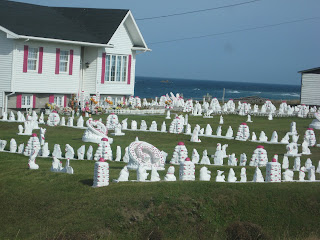 We visited our Lady of Mercy church, the largest wooden structure in Newfoundland,
 checked out Red Island, named for its red cliffs,
 and visited the province’s only alpaca and llama farm. We drove across a wooden bridge and arrived at another wooden church, Holy Trinity Anglican church which was built in 1914 and
  while it is not the largest, it well may be the oldest, in the community.
 Framed by the Long Range and Anguille mountains, and the Atlantic Ocean, Codroy Valley is comprised of 15 communities and a population of 2,200. A walk thru the Valley’s Wetlands allows you to view up to 200 species of migratory birds. Further along the coast, we stopped to view the Cape Anguille Light Station.
 Since the early 1900s this beacon of refuge and safety has been tended by a member of the Patry family. This site is also the most western site in Newfoundland. We have now been on the farthest points of each side of the island.
 the French. The name reflects the many ships wrecked on these shores. A hike sounded like a good idea so we hiked Harvey’s Trail.
  George Harvey was a local hero famous for saving nearly 200 people in two shipwrecks off the coast of Isle aux Morts. He fished in the summer and rested in the winter. With the fish he caught, he bought commodities like flour, sugar and molasses to tide him and his family over in winter. The weather was rough and there were no other families on the island for company.
  He often buried bodies that would float ashore from shipwrecks he did not even know occurred. Shipwrecks and the Newfoundland coast are two items that belong together, especially at Isle aux Morts. An estimated 3,000 shipwrecks have occurred along the southwest coast over the last 130 years.
 The vessel’s mission was to take a load of Irish immigrants to Quebec City where they were going to make a new life for themselves. George rushed back to his small two room bungalow and told his family what he had seen. Immediately his 17 year old daughter, Anne, and his 12 year old son, Tom, volunteered to go with their father. It was two days before the water was stable enough for them to launch their punt. When it was possible, off they went with their Newfoundland dog, Hairyman, in tow.
 The fierceness of the ocean made going right up to the ship impossible. George decided to keep the boat positioned where it was. With no other way of reaching the stranded voyagers, George tied a rope around his Newfoundland dog, Hairyman, and ordered him into the water and to the vessel. The dog knew just what to do. He fought the big waves and after being driven back several times, he finally reached the brig and was eagerly drawn aboard. Once there, the crew tied another rope around the dog and without any instructions, he returned to his master. With the dog aboard the punt, the Harveys had the task of getting back to the nearest point of land, a little over a mile away. This meant an extreme amount of work on the oars through vicious seas. George Harvey knew only too well the mood of the ocean. It was a good possibility that the punt would capsize and the family could drown. It was a chance he decided to take as about 200 lives depended on him. Luck was on their side that night for the huge sea took them and placed them near the shore. When the sea receded, the punt was land bound. Quickly they tied their boat and began to drag the stout cable that the Despatch had sent to them and strung the cable tightly between ship and land. Though the conditions were hazardous, the crew on the slowly sinking ship set up buoys and soon transported the passengers to land. Just as the last man came off the buoy, the Despatch slid off the rocks and under the sea. George clothed and fed the people with his meager supplies and rowed a long boat eight miles to Port aux Basques to report the wreck. About four days later a ship was sent to retrieve the survivors and took them to their original destination of Quebec City. George received a special medal from King George IV to commemorate the brave rescue. He was also given 100 pounds of Sterling Silver from Lloyds of London.
 We couldn’t resist taking a picture of the local grocery story and filling station that provides services for this small fishing village.
 This is one of the last granite lighthouses on the Atlantic seaboard. It was built in 1871 from a nearby granite quarry.
  The building operated as a lighthouse from 1873 to the 1940s. There were six keepers over the approximately 70 years of the lighthouse’s existence. After it was abandoned, the building fell into ruins. In 1988 the Southwest Development Association and other community groups began the long process of restoring the structure to its former condition. Actual restoration began in 1996 and was completed in two years. The reconstructed lighthouse is furnished with 19th century reproduced furniture and local antiques.
 One remarkable feature is the stone steps within the tower walls which kept the tower from collapsing after it was abandoned.
