Only two days in Quebec and we’ve learned to speak French!!! Well, not really, but we have learned to point a lot. Actually, we were kind of prepared to not like Quebec City. We had heard the usual about the unfriendliness of the folks here and the fact that they would only speak French, but we found all that to be untrue. Most of the people we met in Quebec City were very friendly and those that could speak English did so when they found out we were from the States. They were extremely helpful and we were very pleased with our visit.
On its 400th anniversary, “the cradle of the French presence in North America” opened its door to the world. Artists, performances and magical encounters take center stage in this once-in-a-lifetime get-together. The City of Quebec was founded in 1608 by Samuel de Champlain and is also known as the cradle of French Civilization in North America. It is the capital of Quebec and seat of the National Assembly. Quebec City has a population of 638,000 of which 95% are French speaking. It is the largest province in Canada and one of the safest regions in North America.
We stayed at Au Sous-Bois campground, about 15 miles outside the city. We were able to drive our truck to the Aquarium, about 7 miles away and then catch a bus into town. The bus cost $2.00 per person and was good for as many rides as you wished during the day. We got off at the Ferry and began exploring Old Quebec City.
On its 400th anniversary, “the cradle of the French presence in North America” opened its door to the world. Artists, performances and magical encounters take center stage in this once-in-a-lifetime get-together. The City of Quebec was founded in 1608 by Samuel de Champlain and is also known as the cradle of French Civilization in North America. It is the capital of Quebec and seat of the National Assembly. Quebec City has a population of 638,000 of which 95% are French speaking. It is the largest province in Canada and one of the safest regions in North America.
We stayed at Au Sous-Bois campground, about 15 miles outside the city. We were able to drive our truck to the Aquarium, about 7 miles away and then catch a bus into town. The bus cost $2.00 per person and was good for as many rides as you wished during the day. We got off at the Ferry and began exploring Old Quebec City.
 It was very beautiful and reminded me of what I thought you would see in Paris.
 Many small cobblestone streets with shops and outdoor cafes on both sides and lots of flowers.
After walking around for a while, we decided to have an Italian Buffet at one of the outdoor cafes. The food was very good and fortified us for the walking which we would be doing for the rest of the day.
 The celebrated hotel, Chateau Frontenac, is one of the most photographed spots in old Quebec City.
On top of the Museum of Civilization is a rooftop garden aptly named the Visionaries Garden.
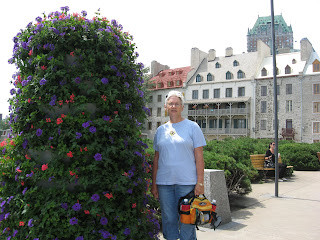 It is a garden for everyone that reflects the cycle of life: it is born, blooms, and shares its riches before returning to the earth.
  Vegetables, herbs and flowers are in abundance along this tiered garden high up above the buildings. It also includes a “talking well”.
 From the depths of the well, children speak to us about their lives, their fears and their hopes while pictures float at the bottom depicting day and night time images.
Located along side the Louise Basin is Espace 400 which is the official headquarters of the 400th anniversary celebrations. Here the grain silos are located which will act as the backdrop for the astonishing Image Mill, the largest outdoor architectural projection ever created.
 The grain silos are used as an enormous screen on which to project striking images from the history of Quebec. This project took three years to develop and two months to set up. Though it was cold and windy, George and I were amazed at the technology for this light and sound show, and glad that we braved the weather to experience it.
Right next to Espace 400 is the Ephemeral Gardens. Eleven avant-garde gardens were created by artists and architects from Quebec, Canada, the First Nations, the United States, France, and the United Kingdom using minerals, plants, sounds and smells.

Located on Cap Diamant, the Citadelle constitutes the eastern flank of Quebec’s fortifications and is known as the Gibraltar of America.
 Construction of the Citadelle began in 1820 and lasted more than 30 years.
 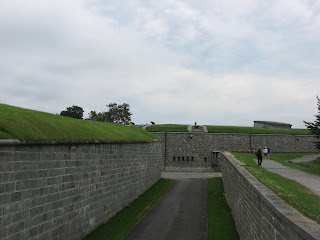 It is star shaped and is an active military base. It has a changing of the guard but since we had just seen the one at the Legislative building in Ottawa,
 we didn’t stay for this one. Looking down from the Citadel you can see the broad boardwalk that flows through the lower town.
All in all, we were very pleased with our visit to Quebec City. The bus service was excellent and the city was very quaint and different from anything we had seen previously. It is well worth a visit. George especially enjoyed lounging around with Mr. Moose.

We are now heading to the Gaspe peninsula in Quebec and will be there for at least a week. From there, we will be entering New Brunswick. We’re not sure what to expect once again on this adventure as we will be hugging the coastline, but at the first opportunity, we’ll update the blog so you can share our trip with us. Til then, stay healthy and happy


 The French colonists were the first to arrive in Montreal, followed by the English, the Scottish and the Irish. Today, 80 distinct ethnic communities are represented in its population. It boasts a rather large underground pedestrian network which appears to just be one continuous mall, leading you by any kind of store you can imagine and almost any type of fast food spot. It definitely makes Houston’s underground look pretty pitiful by comparison.
  George is trying to decide which direction we need to go in the underground tunnel.
 A stone church was built between 1672 and 1683. It was located right in the middle of Notre-Dame Street. By 1800, many parishioners had to listen to mass in the square in front of the chapel because it was no longer large enough to accommodate everyone
 . The west tower, called Perseverance, was the first of the twin towers to be constructed. It was completed in 1841 and houses the great bell, which weighs 10,900 kg. A 10 bell carillon is housed in Temperance, the second tower, which was completed in 1843. The magnificent interior is sculpted in wood. Paintings, sculptures and stained glass windows illustrate biblical passages as well as 350 years of parish history. The organ has four keyboards, 99 stops and approximately 7,000 pipes.
 There are many splendid buildings from the 1700’s and some of the most remarkable 19th century Victorian commercial buildings in North America.
 This charming historical setting has some superb public squares, five history museums, over thirty art galleries and numerous boutiques and sidewalk cafes.
 Built for the 1976 Summer Olympic Games, the Olympic Stadium is the park’s centerpiece. It is topped by the tallest inclined tower in the world, Montreal Tower. After riding in a cable car up the incline, the Observatory provides a view on a clear day of up to 80 kilometers in every direction.
 The same architect who designed Central Park in New York also designed Mount Royal. There are beautiful flower gardens throughout the park.
 Also, found on the slopes of Mount Royal are two of the city’s oldest cemeteries, Mount Royal which covers 165 acres and Notre-Dame-des-Neiges Cemetery which is Canada’s largest cemetery. Since 1854, more than 900,000 people have been buried there. Nearby on the parks outskirts, are the campuses of two universities as well as Saint Joseph’s Oratory which welcomes pilgrims annually.
 It is one of the world’s most visited shrines. The basilica’s huge dome reaches 97 meters and is second only in height to Saint Peter’s Basilica in Rome. The shrine, devoted to Saint Joseph consists of a primitive chapel, a votive chapel, a crypt and a basilica large enough to accommodate 10,000 worshippers.
 And of course, we loved the Beaver Tails which are whole wheat pastries stretched to the shape of a beaver’s tail and float cooked on Canola or Soya oil.
 They are served piping hot and topped with your choice of several delectable toppings such as cinnamon and sugar, chocolate, nuts, etc.
 house the Senate and the House of Commons chambers, the Library of Parliament, and offices for parliamentarians and staff.
 The ceremony is a very stirring military drill set to the music of the Canadian Forces band. It takes place on Parliament Hill in front of the Centre Block. The Old Guard is inspected
 and then turns the key over to the New Guard.
 The ceremony lasts approximately 30 minutes.
  These guards also stand vigil over the Tomb on the Unknown Soldier.
 Its red carpeting and upholstery and a ceiling of gold leaf create an air of regal splendour. The names of former governors general are carved in the ceiling. The Chamber’s upper walls are lined with murals depicting stirring scenes from the First World War. Below them, images of Canada’s flora and fauna are carved in stone and wood. This room is where the Queen of Canada, or the Governor General, her representative, addresses Parliament and gives Royal Assent to bills destined to become law. At the north end of the Chamber is a raised platform with a pair of thrones, the larger of the two for the Queen or the Governor General and the smaller one for the spouse of either the Queen or the Governor General. For regular sitting of the Senate, the Speaker’s chair is placed in front of the thrones, but is removed when the Queen or her representative are present. Senators belonging to the governing political party in the House of Commons sit to the Speaker’s right. To the Speaker’s left sit those senators belonging to all other parties, including those who have chosen to sit as independent senators. Senate proceedings are open to both the public and journalists. When a bill is submitted, the Senate is the group who study it and make any recommendations for change before it becomes law. They also have “strike down” authority, to completely kill a bill that has been recommended. There are currently 105 Senators.
 It is decorated in green carpeting and upholstery, in the tradition of the British House of Commons. The rectangular Chamber is made of white oak and Tyndall limestone from Manitoba. The Speaker is spokesperson and presiding officer of the House of Commons. A Member of Parliament chosen by fellow members through secret ballot, the Speaker ensures that all rules and procedures are followed and oversees the administration of the House. He sits in a throne chair at the head of the room. Stone carvings, stained glass windows and other artistic representations of Canada’s history decorate the Chamber, as a constant reminder of the Canadians that Members of Parliament represent and serve. There are currently 308 Members of Parliament in the House.
 With its graceful arched ceilings and rich sculpture, it links all the elements of the Centre Block together and serves as a fitting setting for national commemorations and ceremonies. In front of the Centre Block stands the Peace Tower, the most striking feature and one of the most recognized symbols on Parliament Hill. The Peace Tower was named in commemoration of Canada’s commitment to peace. On the third floor is the Memorial chamber, a richly carved room of gently light built to honor Canadians who died in the armed conflicts in which Canada has fought since the Confederation. The 302 foot tower also contains an observation area and the Carillon, a series of 53 bells sounded from a keyboard. The largest bell weighs in at 22,400 pounds. The Dominion Carillonneur entertains visitors every day at 2:00 with regular recitals.
 It is the only place that you are not allowed to take pictures inside and it is astounding. Its floor features a beautiful pattern of cherry, oak and walnut. Hundreds of flowers, masks and mythical creatures are carved in the paneling of white pine. In the center of the circular, domed room stands a white marble statue of the young Queen Victoria. When the fire started on February 3, 1916, a conscientious employee quickly shut the metal doors to the library. While other parts of the building were reduced to a charred shell, the library was spared, saving over half a million books and documents.
 Several people dressed in costumes showed up as we were touring and pretended to be characters of that period.
 However, it is only since the 1970’s that volunteers have paid special care and attention to these animals: creating the “cat sanctuary”. All animals have been neutered to ensure the health and stability of the colony and have been inoculated against various diseases. The cats as well as pigeons, sparrows, squirrels, raccoons, chickadees, and even ground hogs,
 are fed on a daily basis. It costs $6,000 per year to take care of them. The Federal government does not contribute anything to this cost. It is primarily made up of contributions.
 tribute to the sacrifices of these brave men and women who were killed in the performance of their duty.
 This is the bell which was housed in the Victoria Tower at the time of the fire. Shortly after striking midnight, the Victoria Bell came crashing down into the building. It was later recovered from the ruins and put on display. The bell is mounted at an angle to symbolize the position it was in when it came crashing down at the stroke of midnight.
 Another of those anomalies that can’t be explained.
 The Centennial Flame is a permanent reminder of the unbounded optimism of the centennial year. Alberta natural gas feeds the flame that burns through the water which flows over the bronze shields of the provinces and territories that existed in 1967. Each of the twelve segments is also ornamented with the floral symbol and the date that the province or territory joined the Confederation.
 Five women are rejoicing over tea because of their victory in the Persons Case of 1929, a landmark step in Canadian women’s struggle for equality. These five women won a legal challenge to have women considered “persons” under the British North American Act, making them eligible for appointment to the Senate.
 From its imposing stone gates, to its magnificent gardens, terraced grounds, medievil turrets and 98 rooms, this fairytale castle is both impressive and bewildering: one cannot help but wonder about the kind of man who would build such a home for himself.
 the central point of the castle, with its soaring 60 foot oak-beamed ceiling. It’s really a bargain at $11.00 a ticket for seniors over the age of 60. It is a self guided digital audio tour and takes you through the castle step by step. We marveled at the beauty of the stained glass dome in the castle’s Conservatory,
  discovered the Pellatt family crest in the Library ceiling, and observed the intricate carving of the paneled Oak Room.
 A serving room originally served two purposes. When formal dinners were held in the dining room, this room was used by servants as a serving room.
  Food was brought here from the kitchens, served on to plates, and then taken into the diners. At other times, this room was an intimate breakfast area for the Pellatts. A breath-taking view of the city rewarded us as we climbed up the turreted towers. There are secret stairways and a luxurious carriage room and stables connected to the castle by an 800 foot tunnel. The stables housed his prized horses and the stalls are constructed of Mahogany while the floors are clad in Spanish tiles.
 The original Gardens of Casa Loma were modeled after an English Gentleman’s Garden containing a series of parterres with gravel paths, vegetable gardens, flowers and fruit trees. A greenhouse complex, featuring a potting shed and conservatory served as a work area for a staff of three gardeners who tended to the magnificent grounds. Today, both formal and informal gardens adorn the beautifully landscaped grounds of this six acre estate. At every turn the senses are delighted by dancing fountains, unusual sculpture, and the dazzling, everchanging colors of a Canadian garden.
 aquatic fossils,
 an ancient Egyptian mummy case, Greek and Roman Artifacts,
  Life in China, Korea, and Japan, and Canada’s First Peoples are just some of the options.
  Another four hours and we just were able to walk thru all the exhibits. It is easily a two day event if you truly wanted to delve into everything. The building’s latest addition is built in the shape of a crystal and provides a very picturesque façade for the museum.
 Once again, if you like museums, this is a must-see!
 Tomorrow we will be heading out and arriving at Ottawa for another fun-packed three days. See you down the road!